+44 7852 806969
 info@acumengcompliance.com
 1 Canada Square, Canary Wharf Estate, London E14 5DY, UK
FCA Authorisation
Authorisations
FCA Authorisation Consultant
UK FCA Authorisation Consultation Service
Getting FCA authorisation wrong is not just a setback; it can cost you months, thousands of pounds, and in some cases, your ability to operate entirely.
Whether you are launching a FinTech startup, applying for a payment institution licence, or seeking authorisation as an e-money institution, the Financial Conduct Authority’s application process is complex, demanding, and unforgiving of poorly prepared submissions.
That is where Acumen Global Compliance comes in.
We are a specialist FCA authorisation consultant firm based in the UK, working with FinTechs, payment companies, crypto businesses, and financial services firms at every stage of the regulatory journey. Our consultants have deep, hands-on experience with FCA Connect applications, regulatory business plans, and the specific requirements the FCA expects to see before granting authorisation.
If you are asking how to get FCA authorisation in the UK, or what documents are required, or why your application might be at risk, this page was written for you.
Quick Answer: FCA authorisation is the formal permission granted by the Financial Conduct Authority (FCA) that allows firms to carry out regulated financial activities in the United Kingdom. Without it, operating as a financial services firm is illegal under the Financial Services and Markets Act 2000 (FSMA).
Get a Free Quote
- +44 7852 806969
- +44 7852 806969
What Is FCA Authorisation and Why Does It Matter?
The Financial Conduct Authority (FCA) is the UK’s primary regulator for financial services firms. Any business wishing to carry out regulated activities, from accepting deposits and issuing e-money to providing investment advice or facilitating payments, must first obtain authorisation from the FCA.
This requirement is not optional. Under the Financial Services and Markets Act 2000 (FSMA), carrying on regulated activities without authorisation is a criminal offence. Penalties include unlimited fines and up to two years’ imprisonment.
For legitimate businesses, FCA authorisation is the foundation on which everything else is built. It signals to customers, investors, and partners that your firm meets the UK’s highest regulatory standards.

Who Needs to Be Authorised by the FCA?
The scope of FCA regulation is broad. Most firms operating within the UK financial sector will require either full authorisation or registration.
Firms That Require Full FCA Authorisation
Payment institutions (PIs) processing payments, money remittance
E-money institutions (EMIs) issuing electronic money, prepaid cards
Consumer credit firms, lending, debt management, and credit broking
Investment firms' portfolio management, investment advice, and dealing in investments
Mortgage lenders and brokers
Insurance intermediaries and underwriters
Crypto asset businesses (certain activities under FCA registration)
FinTech firms offering regulated financial products or services
Appointed Representatives and Limited Permission Firms
Some firms can operate as Appointed Representatives (ARs) under the umbrella of an FCA-authorised principal firm. Others, such as small payment institutions (SPIs) or limited permission consumer credit firms, require registration rather than full authorisation, though the process remains rigorous.
If you are unsure which pathway applies to your business model, speaking with a qualified FCA authorisation consultant before submitting anything is strongly advisable.
The FCA Authorisation Process Step by Step
The FCA authorisation process is methodical. There are no shortcuts, and incomplete applications simply get rejected or delayed. Here is what the journey typically looks like.
Step 1: Pre-Application Assessment
Before submitting anything to the FCA, you need a clear picture of your business model, the regulated activities you intend to carry out, and whether your firm is genuinely ready to meet the FCA’s threshold conditions.
The FCA’s threshold conditions include adequate financial resources, appropriate systems and controls, suitable fit and proper management, and a coherent and compliant business model.
At Acumen, we conduct a comprehensive pre-application gap analysis to identify weaknesses before they become rejection reasons.
Step 2: Building Your Regulatory Business Plan
The regulatory business plan (RBP) is the centrepiece of your FCA application. It must clearly articulate your business model, target market, revenue projections, governance structure, and how you will manage key regulatory risks, including financial crime, AML compliance, and consumer protection.
The FCA scrutinises this document carefully. Vague language, unsupported projections, and missing risk frameworks are among the most common reasons applications stall.
Step 3: Completing the FCA Connect Application
FCA Connect is the online portal through which authorisation applications are submitted. Depending on your firm type, you will need to complete specific application forms, submit financial projections, provide details of key function holders, and demonstrate compliance with relevant regulatory requirements.
For payment institution applications, this includes demonstrating compliance with the Payment Services Regulations 2017 (PSR). For e-money institutions, the Electronic Money Regulations 2011 (EMR) apply.
Step 4: FCA Review and Decision
Once submitted, the FCA has a statutory target of six months to assess complete applications, and up to 12 months for incomplete submissions. In practice, the FCA may issue requests for further information (RFIs), which pause the clock.
Responding to RFIs effectively with clear, evidence-based, regulatory-grade answers is a critical skill. Our consultants manage this process on your behalf, ensuring responses are submitted promptly and correctly.
What Does an FCA Authorisation Consultant Actually Do?
An FCA authorisation consultant provides expert, end-to-end support throughout the authorisation process. This goes far beyond simply filling in forms.
A qualified consultant will:
Assess your business model for regulatory fit
Advise on the most appropriate authorisation pathway (full authorisation, registration, appointed representative)
Draft and review your regulatory business plan
Build your compliance framework, including AML policies, KYC procedures, and governance documentation
Prepare your financial projections and capital adequacy calculations
Complete FCA Connect application forms on your behalf
Respond to FCA queries and requests for information
Prepare your Senior Managers and Certification Regime (SMCR) documentation
Advise on Consumer Duty obligations ahead of authorisation
Support post-authorisation compliance monitoring
At Acumen Global Compliance, we take full ownership of the process. Our clients do not navigate the FCA alone.
Common Reasons FCA Applications Get Rejected
Understanding why applications fail is half the battle. The FCA rejects or significantly delays applications for the following reasons:
Inadequate financial resources, insufficient capital, or unclear funding arrangements
Weak governance and oversight, poorly defined board structures and responsibilities
An incomplete or vague regulatory business plan, a lack of detail on risk management, compliance controls, and business strategy
The absence of documented AML policies, risk assessments, and KYC procedures
Unfit and improper senior individuals, key function holders failing the FCA's fit and proper test
Systems and controls deficiencies, inadequate IT infrastructure, and the absence of a compliance monitoring programme
Failure to demonstrate Consumer Duty readiness particularly relevant for firms servicing retail customers
Avoiding these pitfalls requires both technical compliance knowledge and an understanding of how the FCA evaluates applications. Our consultants have the experience to address each of these areas proactively.
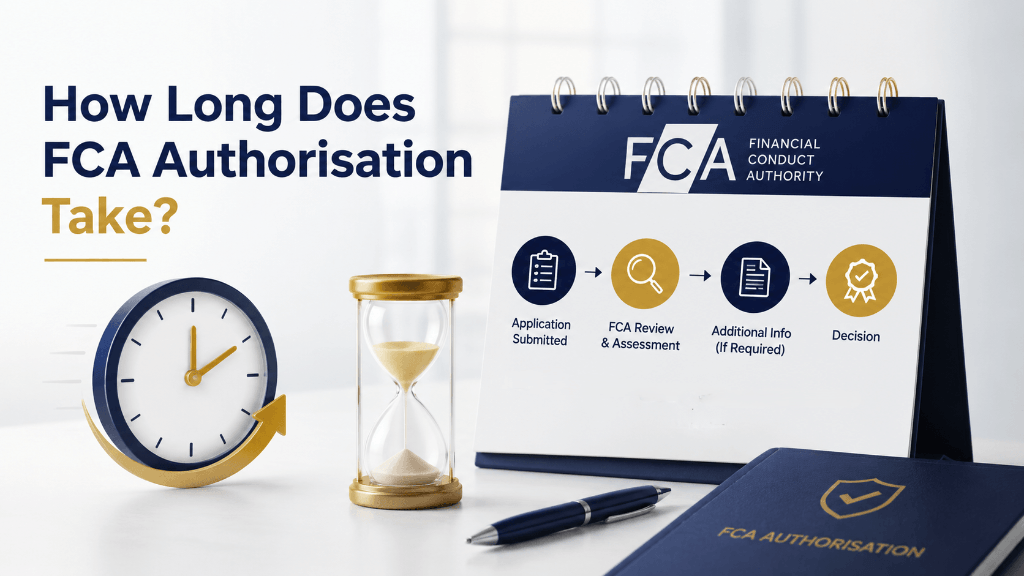
How Long Does FCA Authorisation Take?
For a straightforward application, the FCA targets a six-month decision window from the date of receipt of a complete application.
In practice, most applications take between six and twelve months, and sometimes longer, depending on the complexity of the business model, the quality of the submission, and how quickly the firm responds to FCA queries.
Applications that are properly prepared with comprehensive documentation, a well-constructed regulatory business plan, and a demonstrably compliant governance framework move through the process significantly faster.
FCA Authorisation Costs: What to Expect
The fee payable to the FCA depends on the application category, regulated activities and applicable fee rules. Payment and e-money applications, consumer credit applications, investment-related applications and other regulatory routes can have different fees.
Because fees can change and are not the same for every application, businesses should confirm the current amount for their specific route before budgeting.
The FCA states that application fees are generally non-refundable, including where an application is unsuccessful.
See the FCA’s current authorisation and registration application fees.
These fees are paid directly to the FCA and are non-refundable, regardless of outcome.
Consultancy fees for FCA authorisation support vary based on the scope and complexity of the project. At Acumen Global Compliance, we provide transparent, fixed-fee proposals following an initial assessment of your requirements.
Why Choose Acumen Global Compliance?
There are many compliance consultancies in the UK. What sets Acumen Global Compliance apart is a genuine depth of regulatory expertise, combined with a pragmatic, commercially aware approach that serves the realities of modern financial businesses.
We work with:
- FinTech startups preparing their first FCA application from scratch
- Scale-up businesses seeking to upgrade from appointed representative to directly authorised status
- International firms expanding into the UK market and requiring FCA authorisation
- Established financial services companies undertaking regulatory remediation or seeking new permissions
Our consultants have direct experience working with the FCA’s authorisation teams and understand how applications are evaluated. We do not submit incomplete applications. We do not submit unprepared clients.
What you get with Acumen is a team that has done this before repeatedly, successfully, and across multiple firm types and regulatory contexts.
Our FCA Authorisation Services
We offer a comprehensive suite of FCA authorisation and compliance services:
FCA Authorisation Application Management
End-to-end management of your FCA Connect application
Regulatory Business Plan Drafting
Expert preparation of your RBP to FCA standards
AML Framework Development
Policies, risk assessments, KYC/CDD procedures, and transaction monitoring
SMCR Implementation
Governance frameworks, responsibilities maps, and fit and proper assessments
Consumer Duty Readiness
Gap analysis and implementation support
Compliance Monitoring Programme
Building Your Internal Compliance Infrastructure
FCA Licensing for Remittance Businesses
Specialist support for money service businesses (MSBs)
EMI and API Licence Applications
Guidance on both full and small e-money and payment institution licences
Appointed Representative Services
Support for firms operating under the AR model
Ongoing FCA Compliance Support
Retainer-based compliance monitoring and regulatory advisory
Ready to Start Your FCA Application?
Book a free, no-obligation consultation with one of our senior FCA authorisation consultants. We will review your business model, advise on the right pathway, and give you an honest assessment of where you stand.
FAQs
Frequently Asked Questions
What is the FCA and what does it regulate?
The Financial Conduct Authority (FCA) is the UK’s conduct regulator for financial services firms and financial markets. It regulates around 50,000 firms across banking, insurance, investments, consumer credit, payment services, and e-money. Its primary objectives are consumer protection, market integrity, and promoting effective competition.
Who is required to be authorised by the FCA?
Any firm carrying out regulated financial activities in the UK must be either authorised or registered with the FCA. This includes payment institutions, e-money institutions, consumer credit firms, investment firms, mortgage lenders and brokers, insurance intermediaries, and FinTech companies offering regulated products or services.
How long does FCA authorisation take?
The FCA has a statutory target of six months to assess complete applications. In practice, many applications take between six and twelve months, depending on complexity and the quality of the submission. Applications with missing documentation or inadequate compliance frameworks routinely take longer.
How much does FCA authorisation cost?
The FCA charges application fees ranging from £500 for a Small Payment Institution to £10,000+ for more complex firm types. These fees are paid to the FCA directly and are non-refundable. Professional consultancy costs vary depending on the scope of support required. Acumen provides transparent fixed-fee proposals following an initial assessment.
Can a foreign company get FCA authorisation?
Yes. International firms can apply for FCA authorisation to operate in the UK market. They will need to establish a UK legal entity, demonstrate UK-based governance and oversight, and meet all the same threshold conditions as UK-incorporated firms. Acumen regularly supports international businesses entering the UK financial services market.
What documents are required for FCA authorisation?
Core documentation typically includes a regulatory business plan, financial projections, AML policy documentation, KYC procedures, governance and ownership structure, details of key function holders, systems and controls documentation, and evidence of capital adequacy. The specific requirements vary by firm type and the regulated activities sought.
What happens if you carry out regulated activities without FCA authorisation?
Operating without FCA authorisation where it is required is a criminal offence under the Financial Services and Markets Act 2000 (FSMA). Penalties include unlimited fines and up to two years’ imprisonment. Any contracts entered into by an unauthorised firm may be unenforceable, and customers may have the right to recover money paid.
Do startups qualify for FCA authorisation?
Yes. Many startups successfully obtain FCA authorisation. The FCA does not require firms to have an operating history, but it does require a credible, well-evidenced business plan and demonstrable compliance infrastructure. Proper preparation is particularly important for early-stage firms, as incomplete submissions are among the most common reasons for delays.
Learn More
Related Services
FCA Payments and E-Money
Explore Our FCA Payments and E-Money Services
SMCR Compliance Support
Explore Our API Licence Services
Consumer Duty
Explore Our Consumer Duty Consultancy Services
Ready to Get Started?
Book a free consultation to discuss your compliance needs with our specialist team.